
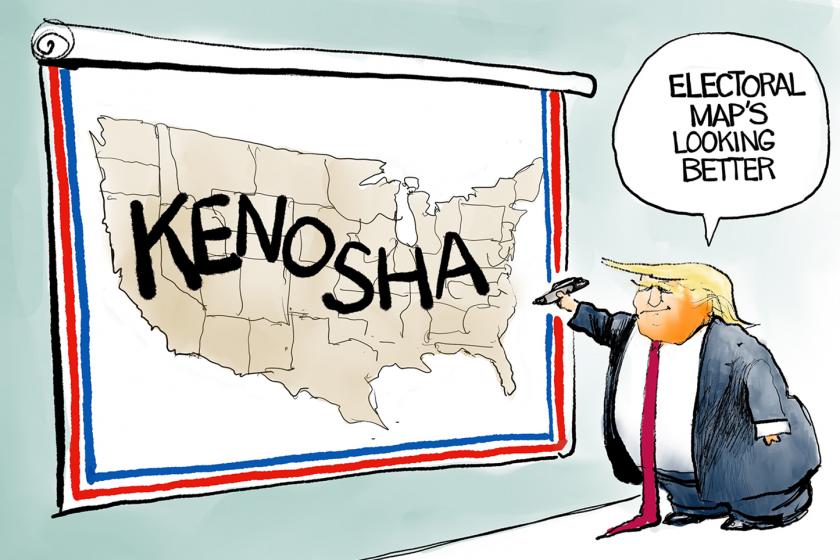
In the span of less than two weeks, the city of Kenosha, Wisconsin has grown from an unassuming dorm community located on the shores of Lake Michigan to a flash point for the social and political failures that have erupted during this period weather election years.
The shooting of Jacob Blake, a 29-year-old black man, by a police officer in Kenosha on August 23 has reignited tensions that sparked a national protest movement after the murder of George Floyd by a police officer in Minneapolis earlier of this year. The demonstrations have also resulted in arson, looting and destruction of property, as well as violence that has left several people dead.
But while Kenosha has been in the news every day of late, many may not be familiar with the city’s former status as a hotbed of American industrial activity and its gradual transition to a center of the service-based economy.
Located approximately 30 miles south of Milwaukee and 50 miles north of Chicago, Kenosha was once home to a sprawling automobile plant run by the former American Motors Corporation. For most of the 20th century, AMC produced millions of vehicles in Kenosha, and from its vast lakefront facilities came iconic cars like the Rambler American and AMC Pacer.
But by the 1980s, Kenosha’s car manufacturing prospects, like those of the American auto industry in general, had worsened. Chrysler continued to produce engines in Kenosha until 2010, when it became a victim of the company’s bankruptcy.
The death of Kenosha’s auto industry cost tens of thousands of jobs and made the city a victim of the decline in American manufacturing. What was once the lifeblood of the local economy, the high-paying union jobs that allowed tens of thousands of families to own their own homes, save for retirement and pursue their American dream, had been eliminated. Like many old industrial hotbeds across the country, Kenosha would have to evolve to cope with the realities of the 21st century economy or it would rust.
It has capitalized on its position between two major metropolitan areas and has become a bedroom community of 100,000 residents, many of whom (before the coronavirus pandemic, at least) commute to work in and around Chicago or Milwaukee.
Amazon’s decision to settle in Kenosha was undoubtedly motivated by its proximity to the bustling markets of Milwaukee and Chicago to the north and south, respectively. As retail and online commerce has grown, so has the main industrial property market located near major cities, from where companies can distribute their products to customers in those population centers. (Private equity giant KKR paid $ 176 million earlier this year to acquire the Kenosha properties that are leased to Amazon, supposedly a record price for industrial real estate in the Chicago area.)
That also reflects the transformation of the American economy. The tens of millions that make up the nation’s dwindling middle class are finding it increasingly difficult to find and keep well-paying jobs with the kind of wages and benefits that would allow them to pursue their own awesome dreams. Such anxieties helped draw more than 1.4 million Wisconsinites to Donald Trump’s message of economic populism in 2016, the first time since 1984 that a Republican presidential candidate won the state.
Already so emblematic of the ruthless dynamic that has transformed the American economy, Kenosha now finds itself at the center of the racial and social tensions that have dominated the national conversation in 2020.